

Our editorial team is comprised of skilled technology experts and developers. To ensure that our research is easy to understand in simple and plain English, we may use AI-assisted tools for grammatical refinement and structural smoothness. However, every technical insight, test, and experience displayed has been fully completed and verified by our human team. All content remains the original property of Droid Expose. See more in our Privacy Policy.
Google’s latest mobile update isn’t just about new icons or smoother animations; it is a fundamental shift in how a smartphone serves its user. At the 2026 Android I/O event, the company pulled back the curtain on Android 17, an operating system defined by agentic AI, aggressive security measures, and a surprising focus on digital well-being.
While Samsung’s One UI 9 is set to inherit the core Android 17 foundation, it takes the experience further by integrating proactive, multi-step automation through Gemini Intelligence. This upcoming update follows the path of One UI 8.5, which focused on refining the mobile experience with high-end generative AI photo tools and text summaries.
Table of Contents
Gemini Intelligence: The Proactive Agent
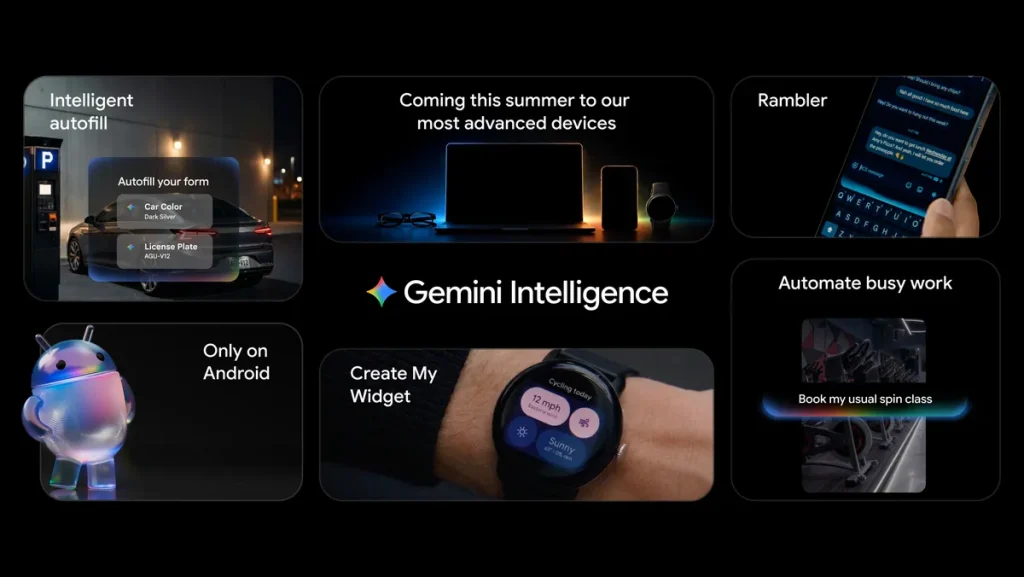
The centerpiece of this update is a suite of features dubbed Gemini Intelligence. Unlike previous AI versions that waited for a specific command, this system is designed to execute complex, multi-step tasks on your behalf.
- In-App Automation: Gemini can now handle background tasks like scanning your email for a student syllabus and automatically adding the required textbooks to a shopping cart.
- Chrome Auto Browse: Inside the Chrome browser, a new agentic experience allows Gemini to research and compare content across multiple tabs. It can even book doctor appointments or reserve parking spots based on the event you are currently viewing.
- Human-in-the-Loop: To maintain user control, the AI will perform the legwork in the background—showing progress via Live Updates in your notifications—but will require a manual confirmation before the final payment or checkout step.
Natural Communication with Rambler
Speech-to-text technology is receiving its biggest upgrade in years through a system called Rambler. Powered by Gemini, Rambler is designed to understand casual, natural language. It automatically strips out filler words like “um,” “ah,” and “oh,” turning messy spoken thoughts into polished text in real-time. Interestingly, it also supports multilingual speakers, recognizing and accommodating shifts between different languages mid-sentence.
Breaking the Doomscrolling Cycle
Google is also taking a stand against social media fatigue with Pause Point. When a user opens a traditionally distracting app, Android 17 can intervene with a scaled-back interface that encourages the user to take a moment to breathe. It then suggests more productive alternatives, such as opening a book in Google Play Books or setting a strict timer to prevent a five-minute check from turning into an hour-long session.
Creator Tools and Quality of Life
For content creators, the update introduces Screen Reactions, allowing users to record their screen and their selfie camera simultaneously while the software automatically removes the background around the creator. Instagram users will see optimized photo and video quality, while professional editors can look forward to the upcoming Adobe Premiere app for Android.
A Modern Fortress: Security and Quantum Safety
Security is seeing two major shifts: one for the present and one for the future.
- Present-Day Theft Protection: New features make it harder for thieves to access data by reducing the number of allowed PIN/password attempts and increasing wait times. A Mark as Lost feature now ensures that biometric authentication is mandatory to turn off a device. Additionally, Android 17 can detect suspicious calls by communicating with your banking app in the background to verify if a caller is a genuine bank representative.
- Future-Proofing: Android 17 marks the first phase of a post-quantum transition. By incorporating ML-DSA into the Android Verified Boot, Google is ensuring that devices are protected against future quantum computing threats that could eventually break current encryption standards.
Release Timeline and Compatibility
The stable release of Android 17 is expected in June or July 2026. As usual, the rollout will be staggered, with Pixel and flagship Samsung Galaxy devices being the first in line.
- Google: Support extends back to the Pixel 6 series.
- Samsung: Devices from the Galaxy S22 series and newer are expected to be eligible.
- Others: OnePlus (11 and above) and Xiaomi (13T and above) users can also expect the update shortly after the initial launch.