

Our editorial team is comprised of skilled technology experts and developers. To ensure that our research is easy to understand in simple and plain English, we may use AI-assisted tools for grammatical refinement and structural smoothness. However, every technical insight, test, and experience displayed has been fully completed and verified by our human team. All content remains the original property of Droid Expose. See more in our Privacy Policy.
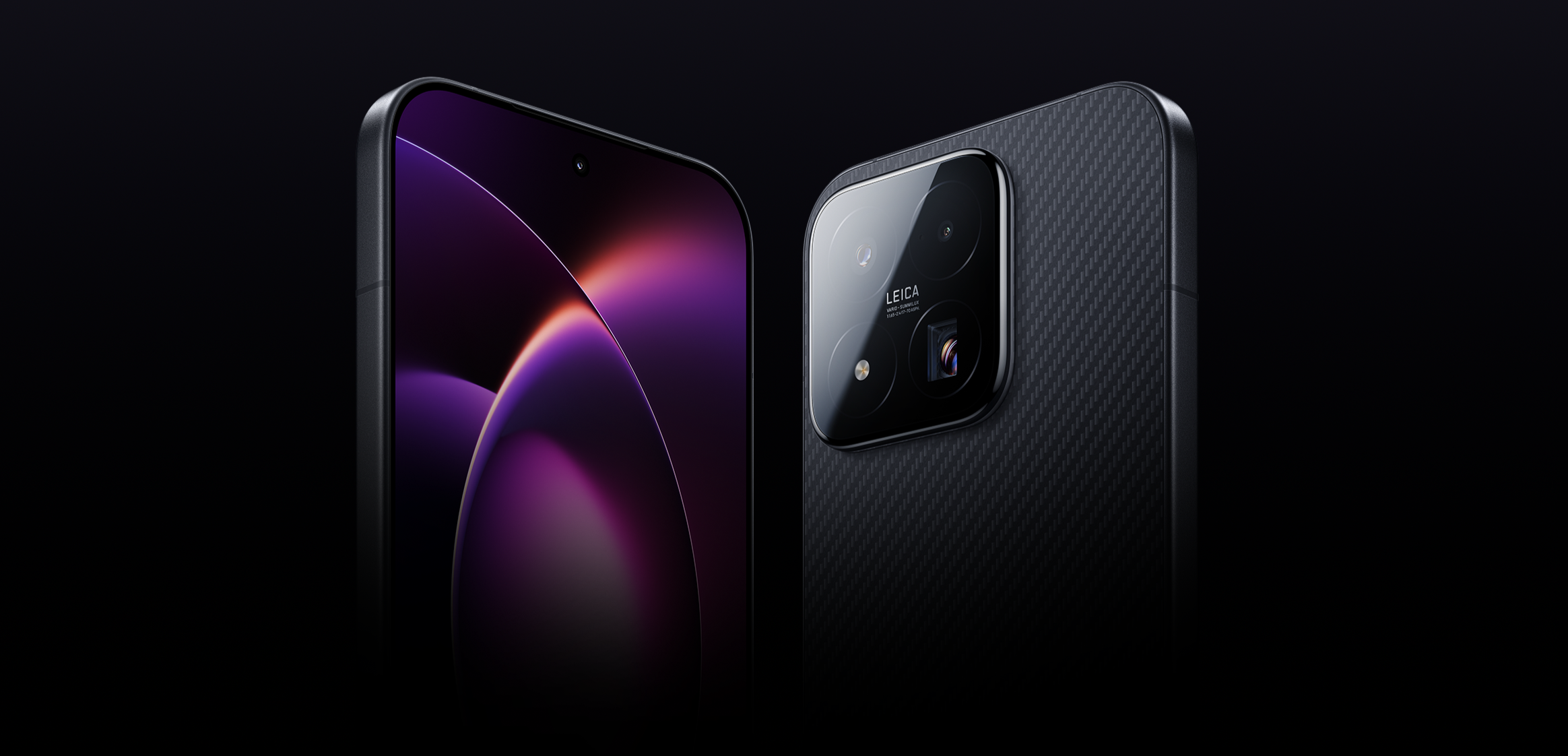
Xiaomi announced the 17 Max on May 21, 2026, at a product event in China. The phone is a late addition to the Xiaomi 17 series, which first launched back in September 2025, and it comes with the biggest battery Xiaomi has ever fitted inside one of its main-lineup flagships 8,000mAh alongside the Snapdragon 8 Elite Gen 5 chip, a 6.9-inch LTPO AMOLED display, and a Leica-branded triple camera system built around a 200-megapixel main sensor. It starts at CNY 4,299 for the base configuration. There is no confirmed global launch at the time of writing.
Table of Contents
How It Fits Into the Xiaomi 17 Family
The Xiaomi 17 series originally launched with four phones: the standard Xiaomi 17, 17 Pro, 17 Pro Max, and 17 Ultra. It skipped the “16” generation entirely to move straight to the 17 line, expanding the lineup to include the T-series. The 17 Max slots in as a fifth model, positioned just below the Pro Max but with a larger battery. The Pro Max ships with a 7,500mAh cell and includes a secondary rear display panel. The Max drops that secondary screen but steps up to 8,000mAh and swaps in a new 200-megapixel main camera that the Pro Max does not carry.
Outside China, Xiaomi has only released the base Xiaomi 17 and the 17 Ultra. The Pro, Pro Max, and now the Max are all China-market-only releases, and nothing suggests that pattern is about to change for the 17 Max.
Battery Technology: Why 8,000mAh at 8.2mm Is Worth Noting
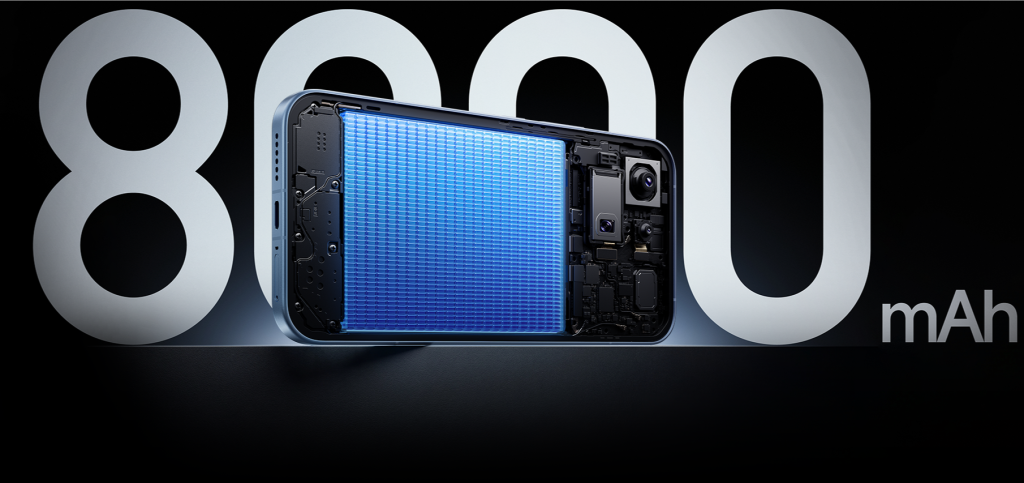
The 17 Max uses what Xiaomi calls Jinshajiang silicon-carbon battery technology. Most smartphone batteries use graphite as the anode material like the Realme 16T 5G features a traditional 8000mAh Lithium-Polymer (Li-Po) Titan Battery, but the 17 Max uses silicon-carbon anodes store more lithium ions per unit volume than graphite, which is how Xiaomi gets to 8,000mAh without the phone ballooning in thickness or weight. Xiaomi states the cell achieves an energy density of 894Wh/L with 16% silicon content in the anode.
In practical terms, that chemistry is what allows the Pixel Black version of this phone to weigh 219 grams and measure 8.15mm thick. The White and Sky Blue models use a glass back instead of fiberglass, which adds roughly six grams and brings thickness to 8.2mm. A conventional graphite cell at 8,000mAh capacity would push a phone well past 10mm and considerably heavier. The silicon-carbon approach closes that gap, though it is worth noting that silicon-carbon batteries tend to degrade faster over charge cycles than graphite this is a known trade-off with the technology that Xiaomi has not specifically addressed in its launch materials.
Managing the battery at this scale requires more than just the cell itself. Xiaomi built two in-house chips for this purpose. The Surge P3 handles fast charging control, and the Surge G2 manages battery health and overall power efficiency. On the charging side, the phone supports 100W wired charging via the 100W PPS protocol, 50W wireless charging, and 22.5W reverse charging both over wire and wirelessly meaning it can top up other devices as well. Offering 50W wireless on an 8,000mAh phone is not common, as the heat involved is harder to manage at this battery size. Xiaomi addresses that partly through the 5,500mm² vapor chamber cooling system inside the phone, which serves double duty for both the chipset and charging thermals.
Display: 6.9 Inches, LTPO, 3,500 Nits
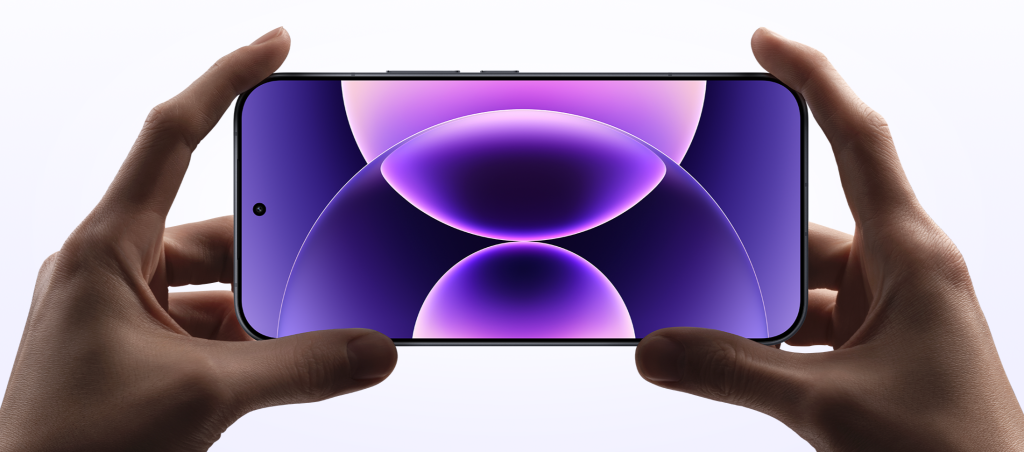
The screen is a 6.9-inch LTPO AMOLED panel with a resolution of 2,608 x 1,200 pixels. At that size and resolution, pixel density works out to around 420 pixels per inch, which is sharp enough in everyday use that individual pixels are not visible. The aspect ratio is 19.5:9 taller and narrower than older 16:9 panels, which suits scrolling through long pages and watching modern widescreen content.
LTPO means the panel can vary its refresh rate between 1Hz and 120Hz automatically depending on what is on screen. At 1Hz, the panel is refreshing barely at all useful when displaying a static notification or lock screen while fast motion like gaming or scrolling steps up toward 120Hz. Xiaomi’s SuperPixel technology works alongside this to maintain resolution quality while keeping the panel’s power draw lower during normal use. On a phone with 8,000mAh, display efficiency matters less in absolute terms than it would on a 4,500mAh device, but the combination still contributes to overall endurance.
Peak brightness is 3,500 nits, matching the figure Xiaomi achieved on the 17 Pro Max. The panel covers Dolby Vision, HDR10+, and Xiaomi’s own HDR Vivid standard. PWM dimming runs at 1,920Hz for context, anything above roughly 1,000Hz sits well outside the range that the human eye can detect as flicker, so the 17 Max should be comfortable for extended use even for people who are sensitive to lower-frequency PWM displays.
The front glass is Xiaomi Shield Glass 3.0, the company’s current protective glass generation. Bezels are thin and even on all four sides, with a centered punch-hole cutout at the top for the selfie camera. Screen-to-body ratio is 90.5%. The phone is IP68 rated, which covers dust protection and water immersion up to 1.5 meters for 30 minutes.
Chipset: Snapdragon 8 Elite Gen 5
The Snapdragon 8 Elite Gen 5 Qualcomm model number SM8850-AC is the chip inside the 17 Max. It is built on a 3nm manufacturing process and is the same silicon Qualcomm is currently shipping in its top Android partners’ flagship phones for 2026, including the 17 Pro Max. The CPU is an eight-core design split into two clusters: two Oryon V3 Phoenix L performance cores running at up to 4.6GHz for demanding workloads, and six Oryon V3 Phoenix M efficiency cores at 3.62GHz for everyday tasks. The GPU is the Adreno 840.
The 5,500mm² vapor chamber handles sustained thermal output. Xiaomi says the phone runs graphically intensive games at maximum settings without throttling, which is the standard claim for this chip generation. Whether that holds for long sessions depends heavily on ambient temperature and use conditions, but the vapor chamber size is genuinely large and should help.
Memory comes as 12GB or 16GB of LPDDR5X RAM. Storage is 256GB or 512GB of UFS 4.1, which is the fastest flash storage standard currently available in consumer smartphones. There is no microSD card slot.
Camera System: Three Leica-Branded Lenses
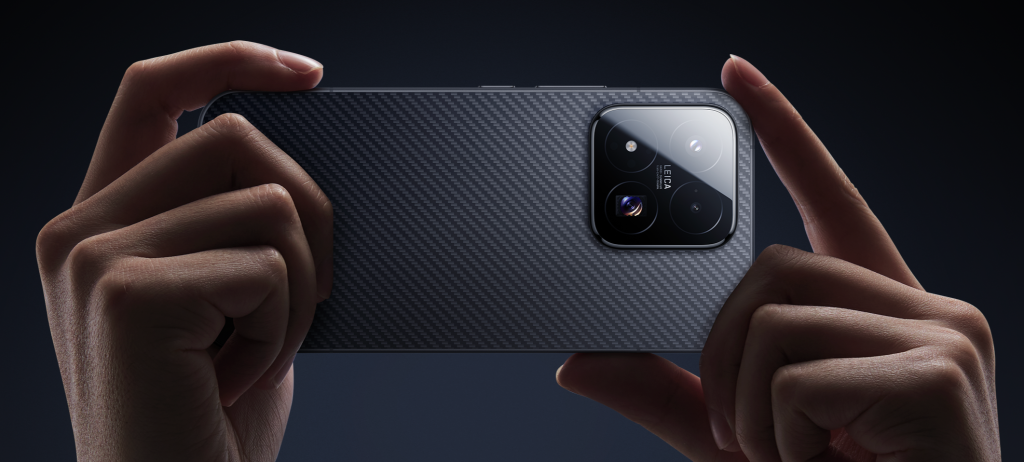
The rear camera setup consists of three sensors, all carrying Leica branding on the lens. The system covers a standard wide, a 102-degree ultrawide, and a 3x periscope telephoto.
The main camera uses a Samsung ISOCELL HP9 sensor measuring 1/1.4 inches — one of the larger sensor formats currently found in smartphones. It shoots at 200 megapixels, paired with a Leica Summilux lens at f/1.65 and a 23mm equivalent focal length. Most of the time, the camera uses pixel binning, combining multiple pixels into one for cleaner output at lower resolutions. The full 200-megapixel mode is available when maximum detail is the priority. Xiaomi has applied what it calls an ultra-high transmittance pyramid coating to the lens elements, designed to reduce internal reflections and improve the amount of light reaching the sensor. Stabilization is handled by Hyper OIS, Xiaomi’s current optical image stabilization implementation, and the sensor supports multi-frame fusion computational photography for improved dynamic range and detail.
The telephoto lens uses a Sony IMX882 sensor at 1/2 inch inside a periscope optical design. A periscope arrangement uses a prism to redirect light sideways through the phone’s body, allowing a longer focal path — and therefore more optical zoom without the lens protruding from the back of the device. This particular setup offers 3x optical zoom and up to 6x lossless zoom. It also supports telemacro photography down to 15cm from the subject, which gives it a close-focus capability that standard telephoto lenses lack.
The ultrawide uses a 50-megapixel OmniVision OV50M sensor with a 102-degree field of view and an f/2.4 Leica lens. At 50 megapixels, the ultrawide retains considerably more detail than the 12-megapixel ultrawides that were standard across much of the industry until recently.
The front camera is a 32-megapixel OmniVision OV32D40 sensor behind an f/2.2 lens with a 21mm equivalent focal length. It records video at up to 4K and 60fps, which is ahead of several competing front cameras that cap out at 4K and 30fps.
On the video side, the rear camera handles 8K at 30fps in HDR, 4K at up to 120fps, 4K at 30 or 60fps in 10-bit Dolby Vision HDR, and 1080p slow-motion up to 960fps. Gyro-EIS operates across all video recording modes. Xiaomi also confirmed the phone supports 4K live streaming directly from the camera app.
Build and Design
The 17 Max measures 162.9 x 77.6mm with a flat display, a flat aluminum frame, and a flat back panel. The camera housing is a rounded rectangle in the upper-left corner of the back a straightforward layout compared to the larger circular camera clusters some other manufacturers are currently using. Leica branding appears on the camera housing.
As mentioned, the Pixel Black version uses a fiberglass back and comes in at 219g and 8.15mm. The White and Sky Blue versions use glass, measuring 8.2mm and 225g. Both accommodate two nano-SIM cards. There is no headphone jack.
Audio and Connectivity
The speaker system is stereo with symmetrical placement on both ends of the phone and Dolby Atmos support. Xiaomi says the speakers are 1115X-tuned, the same driver configuration used in other recent Xiaomi flagships. A four-microphone array handles call and recording audio. There is no 3.5mm jack, but the USB-C port supports 24-bit/192kHz Hi-Res audio output. Bluetooth 5.4 handles wireless audio with support for aptX HD, aptX Adaptive, and LHDC 5.
The USB-C port is USB 3.2 with DisplayPort output and OTG support, so the phone can drive an external display or connect to USB peripherals directly. Wireless connectivity includes Wi-Fi 7, NFC, and an infrared blaster on the top edge. GPS covers dual-band L1 and L5 across GPS, BeiDou, Galileo, QZSS, NavIC, and GLONASS. The in-display fingerprint sensor uses ultrasonic technology rather than optical, which performs more reliably with wet or dirty fingers.
There is no FM radio tuner.
Software: Android 16 with HyperOS 3
The phone ships with Android 16 and HyperOS 3. HyperOS 3 is Xiaomi’s current software interface, responsible for the home screen, system apps, and cross-device integration with Xiaomi’s broader product ecosystem including tablets, televisions, and smart home hardware. The XiaoAI assistant is built in. Xiaomi has not announced a specific long-term software support timeline for the 17 Max at launch.
Pricing and Availability
The Xiaomi 17 Max went on pre-order on May 21, 2026, with sales beginning May 25, 2026. Four storage and memory configurations are available in China.
The 12GB RAM and 256GB storage base model starts at CNY 4,299, which converts to roughly $595. The 16GB and 256GB version is CNY 4,599, or approximately $635. Moving to 512GB storage, the 12GB RAM version costs CNY 4,899 — around $675 — while the top-end 16GB RAM and 512GB model is priced at CNY 5,299, around $730. If a European release were to happen based on current currency conversion rates, the base model would land near €610, though no European or global launch has been confirmed or indicated by Xiaomi.
Full Specifications at a Glance
The Xiaomi 17 Max is a 6.9-inch phone with a 2,608 x 1,200 LTPO AMOLED display, Snapdragon 8 Elite Gen 5 processor, 12GB or 16GB LPDDR5X RAM, 256GB or 512GB UFS 4.1 storage, an 8,000mAh silicon-carbon battery with 100W wired and 50W wireless charging, a 200-megapixel Samsung HP9 main camera with Leica Summilux optics and Hyper OIS, a 50-megapixel Sony IMX882 periscope telephoto with 3x optical and 6x lossless zoom, a 50-megapixel OmniVision OV50M ultrawide covering 102 degrees, a 32-megapixel OmniVision front camera, IP68 water resistance, Wi-Fi 7, Bluetooth 5.4, NFC, USB 3.2 with DisplayPort, an ultrasonic in-display fingerprint sensor, stereo speakers with Dolby Atmos, Android 16 with HyperOS 3, and a weight of 219g or 225g depending on back material. It comes in Pixel Black, Sky Blue, and White.
Who This Phone Is For
The 17 Max makes sense for people who want a full flagship-specification phone not a mid-range device trimmed down to accommodate a large cell and who genuinely need extended battery endurance. The 8,000mAh capacity with silicon-carbon chemistry is the primary reason to choose this over the 17 Pro Max, which has a bigger feature set on paper with its secondary display but a smaller battery. The camera hardware is current top-tier, the chip is the best available in Android phones right now, and the 50W wireless charging is a practical convenience that many large-battery phones skip.
The limitations worth knowing upfront: it is a China-only release with no confirmed global availability, the silicon-carbon chemistry raises some long-term cycle degradation questions that time will answer, there is no FM radio, no card slot, and no headphone jack.